
COP A Seat: A Primer on UN Conference of the Parties (COP) Processes
By Alyssa Ng

To view this as a flip book, click here.
You may have heard of a COP, in big headlines about climate emergencies, but we don’t often hear any discussion about what a COP is. A COP, or Conference of the Parties, is the top body of the UN, composed of representatives from all parties that have ratified the framework for the convention, that hosts convenings and makes agreements1. At these convenings, government officials, civil society and other stakeholders gather to discuss pressing issues. Frequency of COP meetings vary; some meet yearly, others meet every few years. COPs rotate among five regional groups: Western Europe and Other, Latin America and the Caribbean (GRULAC), Africa, Asia-Pacific, and Eastern Europe. A country from a selected regional group bids to become a host country. The host country then selects a president to lead the COP2.
The United Nations Framework Convention on Climate Change meets yearly and is the best known COP. It is the sister convention to the Convention on Biological Diversity (CBD COP) and United Nations Convention to Combat Desertification, collectively referred to as the Rio Conventions. Other examples include the Convention onInternational Trade in Endangered Species of Wild Fauna and Flora and the Convention on the Conservation of Migratory Species of Wild Animals.
What Happens at a COP?
Each COP has a responsibility to adopt new agreements with new goals or to assess progress towards goals. A COP’s focus may shift between these tasks depending on the meeting’s timing3.
Pavilions are rooms or spaces where a party or observer organization can host events and informal discussion. They are important for the transparency of the COP and a place where it is easier to interact with others of all backgrounds4.
Negotiations are in a managed space and depending on the status of negotiations, they can be open to observers of the conference or in closed-door sessions amongst heads of states. Members of the public do not participate in discussions5.
CBD COP-15 Biodiversity Goals Set
As climate change, environmental degradation and pollution intensify, protecting, restoring and conserving biodiversity become consequential steps toward preserving culture, food systems transformation and climate goals. Some communities, particularly Indigenous and faith communities, consider biodiversity to be intrinsically valuable, aside from the ways biodiversity benefits humans.
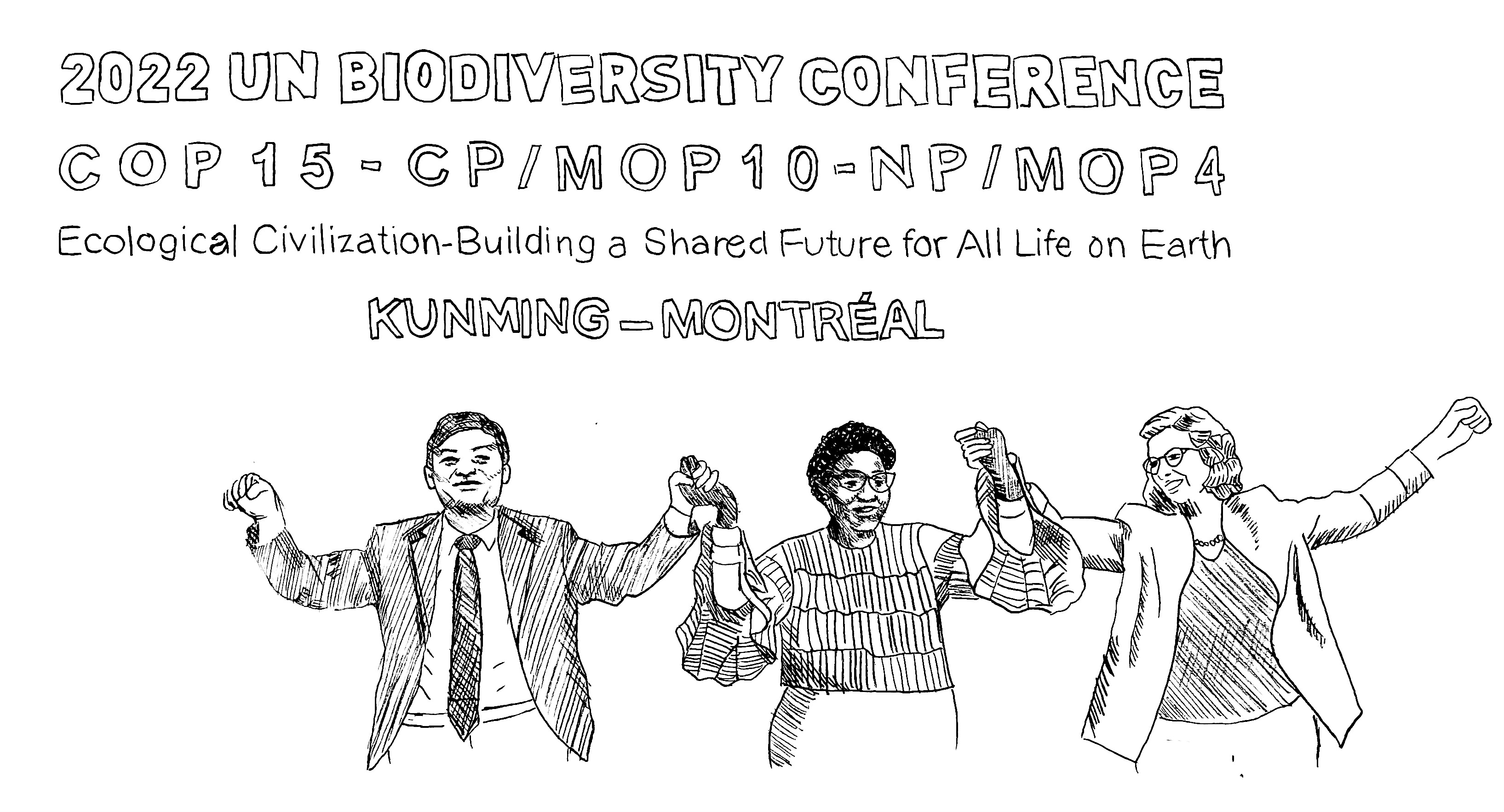
In December 2022, China and Canada hosted the 15th Convention on Biological Diversity. (It was supposed to be hosted in Kunming in 2020, but was postponed due to the COVID pandemic.) The conference served as an opportunity to assess progress since the last substantial targets, the Aichi Targets, were set in 2010 in Aichi, Japan. The 20 Aichi Targets were a huge disappointment; none were achieved during its 10 year timeline. Only six targets were found to be “partially achieved” by a 2020 UN assessment report.
Now, Member States need to confront past failures and incorporate solutions into new targets to guide countries until 20306.
Ministers debated over bracketed text* about all aspects related to biodiversity—from finance to pesticides—until the last day of the conference when the Global Biodiversity Framework (GBF) was finally adopted. The framework outlines 23 targets, including7 :
Conservation of 30% of the world’s water and land (“30x30”)
Halving global food waste
Identifying and eliminating, phasing out, or reforming harmful incentives that damage biodiversity
Minimizing the impact of climate change and ocean acidification on biodiversity
Mobilizing at least $200 billion per year in domestic, international, public and private biodiversity-related funding by 2030
One of the most controversial yet ambitious targets to be included in the GBF is Target 3, the conservation of at least 30% of terrestrial, inland water, and coastal and marine areas. It raises the ambition of what was previously advocated for under Aichi Target 11, which was to protect 17% of land and 10% of coastal and marine areas8.
Although designating more protected areas to achieve 30x30 seems noble, if implemented inequitably, it could violate the rights of Indigenous peoples. Indigenous peoples, a demographic that makes up less than 5% of the world’s population yet protects 80% of the Earth’s biodiversity, could be removed from their ancestral lands under the guise of conservation, such as the forced eviction of Massai peoples’ by the Tanzanian government9. The fortress conservation model is grounded in the belief that ecosystems thrive when they are isolated from humans. This type of thinking disregards the idea that humans are part of nature and that Indigenous peoples have been implementing sustainable practices for centuries. When implementing the GBF, countries must avoid the fortress conservation model.
The GBF shows enormous cooperation among countries for halting biodiversity loss. Conversations during the debate highlighted the tension between harm caused by current activity and strides needed to reach new targets. Biodiversity is vital to the survival of ecosystems. With increasing biodiversity losses, an ecosystem may reach a tipping point and collapse altogether. Ecosystem services provided by healthy ecosystems include defense against natural disasters, mitigation of climate change, necessary material and economic resources, and spiritual and cultural connections.
Signatories ≠ Success
Despite the GBF’s adoption, obstacles stand in the way of success.
The GBF is not legally binding, but countries will be required to show their progress on meeting targets through national biodiversity plans, known as NBSAPs. A lack of legal accountability hinders most UN agreements. The Paris Agreement establishes a target of preventing global temperature rise from exceeding 2°C, and ideally staying below 1.5°C. Despite it being a significant goal that could save the Earth from passing a tipping point—quite literally a life-or-death situation—the temperature goals are not legally binding targets10. Although the GBF was widely celebrated as a “Paris moment” for biodiversity, we cannot let it follow the same path and remain words on a page.
One major player is absent from the CBD COPs: the USA. The US has not ratified the CBD treaty due to partisan politics. President Clinton signed it in 1993 and sent it to the Senate for approval, where it languished. Trepidation over constricting America’s freedom to establish their own environmental regulations and supporting other nations financially to help conserve their natural resources muddied the Senate floor and eventually led to the treaty’s demise. Since then, no other President had attempted to pass it again11. The CBD treaty is not the only treaty that is subject to political opinion in the US; the US was a lead party in creating the Paris Agreement at UNFCCC COP 21, but President Donald Trump later initiated the process to withdraw from the agreement during his presidency. Following the next election, under President Biden the USA rejoined the agreement—only 107 days after the Trump Administration had left it12.
Even signatory countries are sometimes unhappy. In the final stretch of CBD COP-15 negotiations to establish the Global Biodiversity Framework, a representative from the Democratic Republic of Congo opposed adopting the text because it lacked financial support to implement the GBF; the country is home to a vast amount of wildlife and the second largest rainforest in the world13.
The negotiator did not express it formally, however, so the agreement was adopted.
Within the existing environmental fund called the Global Environment Facility, following hostile debates, finance flows to support GBF implementation will be funneled into a special trust fund14. The fund is expected to be established by the next CBD COP meeting (which occurs every two years) in 202415. The alternative is to create an entirely new financing facility, but countries worry that it would take even longer to set up, delaying completion of goals.
Why Do We Continue With COPs?
Why would anyone consider COPs to be important knowing past failures and lack of binding commitments?
It's a fair question. Let’s take a look at some successful COP moments:
Developing Partnerships: Macron & Mottley
Multilateral Development Banks (MDBs) have the duty to support countries, particularly those of low and middle income, not only to protect and restore their biodiversity but also to adapt and mitigate climate change. Countries on the receiving end of the support are critical of MDB’s negligent response to the crisis. In a fierce speech at UNFCCC COP27, Prime Minister of Barbados Mia Mottley unveiled the Bridgetown Initiative/ Bridgetown Agenda to address the inefficiencies of the IMF and the World Bank. She highlighted MDB failures in providing liquidity to halt the debt crisis, expanding multilateral lending to governments, using windfall taxes on oil companies for loss and damage funding, and attracting private finance. Although some denounced this reform as radical, it attracted the attention of many—including French President Emmanuel Macron. He and Mottley met in June 2023 at the Summit for a New Global Financial Pact161718.
The idea of scaling up climate financing garnered support from others as well, such as US Special Presidential Envoy for Climate John Kerry and IMF Managing Director Kristalina Georgieva19.
While the Bridgetown Agenda may have gained support regardless of where it was announced, voicing it at a COP, where other powerful voices are, helped it gain traction.
Setting Goals: Montreal Protocol
The 1985 Vienna Convention for the Protection of the Ozone Layer called for Member States to acknowledge the harmful effects of chlorofluorocarbon (CFC) compounds, which depleted the ozone layer. The conference acted as a space for a foundation of principles to be crafted. The 1987 Montreal Protocol on Substances that Deplete the Ozone Layer established mandates for countries to take specific actions to protect the ozone layer20. The Montreal Protocol was later amended to include the reduction of hydrofluorocarbons and other ozone-depleting chemicals. Additionally, it is legally binding, with mandatory targets for countries, and has a funding mechanism for developing countries21. Both the Vienna Convention as well as the Montreal Protocol reached universal ratification – something that is still quite rare to this day2223.
The international cooperation on this issue is paying off because the world has seen remarkable progress in the recovery of the ozone layer. The UN Environment Programme reported that 99% of banned ozone-depleting substances have been phased out, and if current policies remain in place, the ozone layer in most of the world will recover by 204024.
Raising Awareness: Climate Justice
During COP27, Tuvalu announced its plans to build a virtual version of itself to preserve its culture and landscape, which would make it the first country to replicate itself in the metaverse25. Tuvalu, a group of nine islands in between Australia and Hawaii, is a small island developing state in the Pacific, also known as SIDs. Rising sea levels are encroaching their low-lying land and will eventually force communities to leave their homes. According to some estimates, the whole nation is expected to be entirely underwater by the end of the century26. SIDs are some of the places most vulnerable to climate change, despite being responsible for less than 1% of global emissions27.
Tuvalu’s foreign minister explained at COP27 that Tuvalu felt like they needed to pursue this alternative because the rest of the world was not demonstrating a sense of urgency about climate change. He warned that this could be the fate for other countries.
A Closing Word
The UN’s biggest advantage is being able to bring all types of stakeholders together: it's where global affairs meet national and local levels. Its convening power is like no other; conversations among leaders who may never have crossed paths in their daily work happen here. The power of a conversation is often underestimated. It can spark partnerships, the creation of global goals, and bring awareness to issues that are overlooked during times of international ambition.
Conference of the Parties (COP). (n.d.). UNFCCC. Retrieved September 13, 2023, from https://unfccc.int/process/bodies/supreme-bodies/conference-of-the-parties-cop
Conference of the Parties (COP). (n.d.). UNFCCC. Retrieved September 13, 2023, from https://unfccc.int/process/bodies/supreme-bodies/conference-of-the-parties-cop
Tsvetkova, K. (2022, December 8). COP27: Key Outcomes from the UN Climate Talks in Sharm el-Sheikh. World Resources Institute. Retrieved September 13, 2023, from https://www.wri.org/insights/cop27-key-outcomes-un-climate-talks-sharm-el-sheikh
Wilson, A., & Romdhane, M. (2021, March 27). What are the COP Pavilions? ClimaTalk. Retrieved September 13, 2023, from https://climatalk.org/2021/03/27/what-are-the-cop-pavilions/
What is the UN COP Climate Change Conference? | Office of Sustainability. (n.d.). UConn Office of Sustainability. Retrieved September 13, 2023, from https://sustainability.uconn.edu/what-is-the-un-cop-climate-change-conference/
Dickie, G. (2022, December 8). Explainer: Why did past targets to protect nature fail over the last decade? Reuters. Retrieved September 13, 2023, from https://www.reuters.com/business/environment/why-did-past-targets-protect-nature-fail-over-last-decade-2022-12-09/
COP15: Nations Adopt Four Goals, 23 Targets for 2030 In Landmark UN Biodiversity Agreement. (2022, December 19). Convention on Biological Diversity. Retrieved September 13, 2023, from https://www.cbd.int/article/cop15-cbd-press-release-final-19dec2022
Lo, V., & Jang, N. (2022, December 6). The Global Biodiversity Framework's "30x30" Target: Catchy slogan or effective conservation goal? International Institute for Sustainable Development. Retrieved November 10, 2023, from https://www.iisd.org/articles/insight/global-biodiversity-framework-30x30-target
Lee, J. (2022, June 15). 'Fortress conservation' violently displaces Indigenous people. Grist. Retrieved November 10, 2023, from https://grist.org/article/fortress-conservation-violently-displaces-indigenous-people/
Gopalakrishnan, T. (2020, February 18). 2020 Climate Targets: The Paris Agreement legally requires better targets this year. Down To Earth. Retrieved September 13, 2023, from https://www.downtoearth.org.in/blog/climate-change/2020-climate-targets-the-paris-agreement-legally-requires-better-targets-this-year-69332
Jones, B. (2021, May 20). Why the US won't join the single most important treaty to protect nature. Vox. Retrieved September 13, 2023, from https://www.vox.com/22434172/us-cbd-treaty-biological-diversity-nature-conservation
Sengupta, S. (2021, February 19). U.S. formally rejoins the Paris climate accord. The New York Times. Retrieved November 10, 2023, from https://www.nytimes.com/2021/02/19/world/us-rejoins-paris-climate-accord.html
Greenfield, P. (2022, December 19). Objection by DRC sours 'paradigm-changing' Cop15 biodiversity deal. The Guardian. Retrieved September 13, 2023, from https://www.theguardian.com/environment/2022/dec/19/objection-by-drc-sours-paradigm-changing-cop15-biodiversity-deal
Andersen, I. (2022, December 20). COP15 ends with landmark biodiversity agreement. UNEP. Retrieved September 13, 2023, from https://www.unep.org/news-and-stories/story/cop15-ends-landmark-biodiversity-agreement
COP15: Nations Adopt Four Goals, 23 Targets for 2030 In Landmark UN Biodiversity Agreement. (2022, December 19). Convention on Biological Diversity. Retrieved September 13, 2023, from https://www.cbd.int/article/cop15-cbd-press-release-final-19dec2022
Osborn, C. (2022, November 11). What Is the Bridgetown Initiative, Barbados's Climate Finance Plan? Foreign Policy. Retrieved September 13, 2023, from https://foreignpolicy.com/2022/11/11/cop27-un-climate-barbados-mottley-climate-finance-imf/
The 2022 Bridgetown Initiative - Foreign Affairs and Foreign Trade. (2022, September 23). Barbados Ministry of Foreign Affairs. Retrieved September 13, 2023, from https://www.foreign.gov.bb/the-2022-barbados-agenda/
Liao, K. (2023, May 9). Not Heard of the Bridgetown Initiative? What to Know About the Game-Changing Plan for Climate Finance. Global Citizen. Retrieved September 13, 2023, from https://www.globalcitizen.org/en/content/climate-change-bridgetown-initiative-mia-mottley/
Osborn, C. (2022, November 11). What Is the Bridgetown Initiative, Barbados's Climate Finance Plan? Foreign Policy. Retrieved September 13, 2023, from https://foreignpolicy.com/2022/11/11/cop27-un-climate-barbados-mottley-climate-finance-imf/
The Vienna Convention for the Protection of the Ozone Layer | Ozone Secretariat. (n.d.). Ozone Secretariat. Retrieved September 13, 2023, from https://ozone.unep.org/treaties/vienna-convention
About Montreal Protocol. (n.d.). UNEP. Retrieved September 13, 2023, from https://www.unep.org/ozonaction/who-we-are/about-montreal-protocol
The Vienna Convention for the Protection of the Ozone Layer | Ozone Secretariat. (n.d.). Ozone Secretariat. Retrieved September 13, 2023, from https://ozone.unep.org/treaties/vienna-convention
About Montreal Protocol. (n.d.). UNEP. Retrieved September 13, 2023, from https://www.unep.org/ozonaction/who-we-are/about-montreal-protocol
Eilish, B. (2022, October 2). . . - YouTube. Retrieved September 13, 2023, from https://www.npr.org/2023/01/10/1147977166/ozone-layer-recovery-united-nations-repor
Metaverse Climate Change | Tuvalu Case Study. (n.d.). Accenture. Retrieved September 13, 2023, from https://www.accenture.com/us-en/case-studies/technology/tuvalu
Kofe, S. (2022, November 23). Tuvalu is recreating itself in the metaverse as climate change threatens to wipe it off the map. Euronews. Retrieved September 13, 2023, from https://www.euronews.com/next/2022/11/23/tuvalu-is-recreating-itself-in-the-metaverse-as-climate-change-threatens-to-wipe-it-off-th
Keo, K., & Jo, Y. (n.d.). Snapshot: Small Island Developing States | Climate Promise. UNDP Climate Promise. Retrieved September 13, 2023, from https://climatepromise.undp.org/research-and-reports/snapshot-small-island-developing-states
Photography Credits:
Planet Labs PBC - Andes, Chile - Edited by Ryder Kimball
ArtHouse Studio - Aerial view of whale diving in ocean
Planet Labs PBC - Lake Balkhash, Kazakhstan - Edited by Ryder Kimball
Frans van Heerden - Bird Perched on Gazelle